

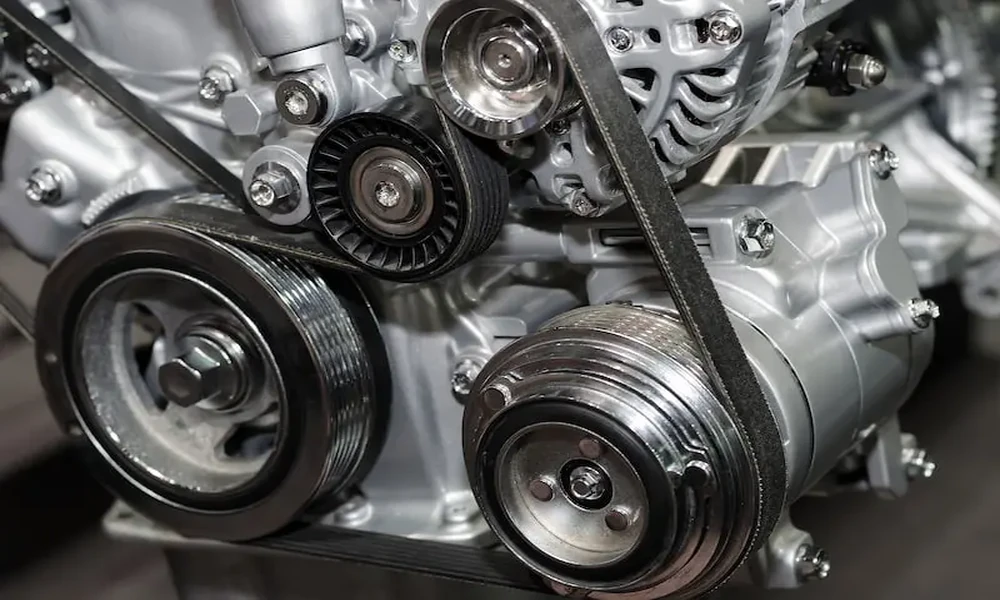
The V belt drive remains one of the most widely used power transmission solutions across Indian industry. Its combination of mechanical simplicity, vibration dampening, flexible shaft arrangement, and proven reliability across decades of industrial application has made it the default choice for driving pumps, compressors, fans, conveyors, and agricultural machinery across virtually every manufacturing and processing sector. Yet despite its ubiquity, the V belt drive is frequently misapplied, undersized, or inadequately maintained, producing premature failures that are entirely avoidable with correct specification and upkeep.
Understanding the V Belt Drive Principle
A V belt drive transmits power through the wedging action of a trapezoidal cross-section belt within matching sheave grooves. As load increases, the belt wedges deeper into the groove, increasing the contact area and grip without requiring a proportional increase in initial tension. This self-compensating mechanism gives V belt drives their characteristic efficiency and their ability to tolerate modest misalignment and shock loading that would damage alternative drive systems.
The efficiency of a well-selected and correctly tensioned V belt drive typically falls between 95 and 98 percent under normal operating conditions, making it competitive with chain drives for many applications while offering superior vibration isolation and quieter operation.
V Belt Manufacturers India: Understanding the Product Range
V belt manufacturers India produce across the full range of classical and narrow V belt cross-sections. Classical sections, designated A, B, C, D, and E in ascending order of cross-sectional area, cover the broadest range of industrial applications from light-duty auxiliary drives through to heavy industrial compressors and agricultural equipment. Narrow or wedge V belts, designated SPZ, SPA, SPB, and SPC, deliver higher power ratings relative to their cross-sectional area, allowing more compact drive arrangements for the same power transmission requirement.
Cogged or raw-edge V belts incorporate transverse notches that increase flexibility, reduce bending stress on small-diameter sheaves, and improve heat dissipation, making them the preferred choice for applications involving small sheaves or elevated operating temperatures. When evaluating V belt manufacturers India, confirm that their product range covers the specific section, length series, and performance grade required for the application rather than assuming all manufacturers cover the full catalogue.
Flat Belt Drive: Where It Remains the Better Choice
While V belts dominate most industrial drive applications, the flat belt drive retains advantages in specific operating contexts. Flat belt drives offer higher efficiency than V belts in some high-speed, long-centre-distance applications, produce lower bearing loads due to their lower running tension, and can accommodate greater centre distance variation without the installation challenges that long V belt replacement involves. In textile machinery, line shafting, and certain precision-drive applications, flat belts remain the technically appropriate choice despite the broader availability and application range of V belt systems.
Selection Parameters That Determine Drive Performance
Correct V belt selection requires a minimum of four input parameters: the power to be transmitted, the speed of the driver shaft, the speed ratio between driver and driven shafts, and the centre distance between shafts. From these inputs, the design power is calculated by applying a service factor that accounts for the drive’s load character, whether it is smooth, moderate shock, or heavy shock loading. The design power determines the required belt section, and the speed ratio combined with the available centre distance determines the belt length and sheave diameters.
Undersized belts, the most common specification error, produce premature slippage, heat buildup, and accelerated wear. Oversize belts, less common but equally problematic, result in excessive initial tension, unnecessary bearing loads, and shafting fatigue. Correct selection from the outset produces drive performance that meets its specification across a service life of thousands of operating hours.
Maintenance Practices That Extend Belt Life
The most consequential industrial v belts maintenance activity is tension verification and adjustment. A belt that is too slack slips under peak load, generating heat and wear on the belt and sheave contact surfaces. A belt that is overtensioned imposes excessive bearing loads and shaft bending stress. Correct tension, verified with a tension gauge rather than estimated by feel, produces consistent, efficient power transmission throughout the belt’s service life. Sheave alignment, groove condition, and the avoidance of oil or chemical contamination complete the maintenance regime that keeps V belt drives running reliably between planned replacement intervals.